
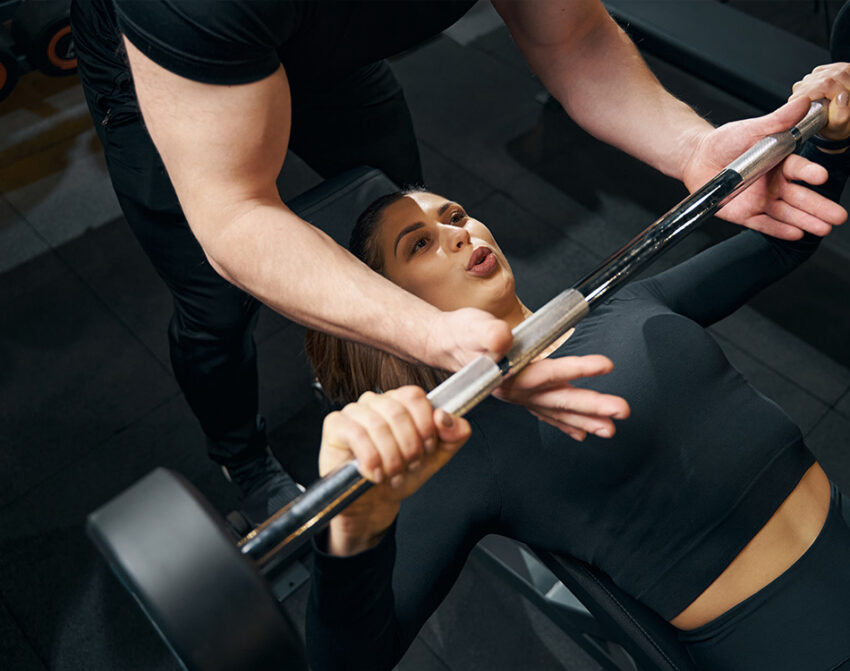

The bench press is generally considered the ultimate upper-body exercise in the gym, yet it remains one of the most underutilised movements in women’s training.
Walking into the free-weight section of a gym, you will usually see the bench press stations dominated by men, while women lean toward hip thrusts, squats, or light dumbbell work.
A persistent myth drives this divide: the fear that heavy upper-body pressing will create a broad, bulky chest.
Coupled with the intimidating culture that often surrounds the bench press area and a common misconception that chest training isn’t relevant to female aesthetic goals, many women skip the exercise entirely.
READ MORE | Looking for a more pec-tacular bust? Don’t skip these exercises
Claim your spot at the bench press
In reality, claiming your spot at the bench press station yields incredible physical and functional rewards:
Upper-body strength and functional power: The bench press is a primary compound exercise. It recruits your pectorals, anterior deltoids, and triceps all at once, building functional push strength that transfers directly to everyday movements like pushing heavy doors, carrying children, or hauling luggage.
Posture and shoulder balance: Balanced muscular development requires pairing pulling movements (like rows) with strong pushing movements. Bench pressing stabilizes the shoulder girdle and reinforces proper upper-back tightness, directly counteracting the rounded-shoulder slouch caused by desk jobs and screen time.
Core and total-body stability: A proper bench press involves your entire body. Engaging your core, maintaining leg drive through your feet, and setting your shoulder blades creates full-body tension that strengthens your midsection far more effectively than isolation exercises.
Preserve bone density: Heavy loading through your arms, shoulders, and spine stimulates bone remodelling. Compound weight-bearing exercises like the bench press play a critical role in increasing bone mineral density and mitigating the risk of osteoporosis later in life.
Sculpted tone without bulk: Women naturally produce a fraction of the testosterone men do, making significant muscular bulk exceptionally difficult to build without specialised hyper-calorie diets. Instead, bench pressing tones the upper chest and triceps, providing structural support that lifts and firms the chest area naturally.
Here’s how to navigate the bench press to reap the rewards of a stronger, more shapely upper body.
Common Mistakes
- Elbow flare:Flaring your elbows out perpendicular to your torso might feel like it’s isolating the chest, but it’s a recipe for shoulder impingement and decreased power.
- Floating feet:Lifting your feet off the floor or resting them on the bench is a trend that needs to end. Without your feet anchored, you lose the leg drive that stabilises your entire upper body.
- Death grip:Using a thumbless grip or letting your wrists cock back at an angle puts the weight on your joints rather than your muscles. It’s precarious, inefficient, and limits muscle fibre recruitment.
Form Fixes
- The 75-degree tuck:As you lower the bar, tuck your elbows slightly toward your ribs (aiming for roughly a 75-degree angle). This creates a natural arch in the movement that protects the rotator cuff and engages the triceps.
- Anchor your feet:Plant your feet flat on the floor, directly under your knees to provide the tension that keeps your torso rock-solid during the press.
- White-knuckle grip:Wrap your thumbs securely around the bar and keep your wrists stacked directly over your elbows. A crushed grip sends a signal to your brain to activate more muscle fibres, leading to an immediate boost in strength.

Author: Pedro van Gaalen
When he’s not writing about sport or health and fitness, Pedro is probably out training for his next marathon or ultra-marathon. He’s worked as a fitness professional and as a marketing and comms expert. He now combines his passions in his role as managing editor at Fitness magazine.










Leave a Reply